
A Product of William S. Hein & Co., Inc.

Databases

Subscriptions

Print Products

Stay in the Know with SCOTUS Cases this 2019-2020 Term!

7 MIN READ

Last week, the Supreme Court of the United States began hearing three separate cases which could determine whether LGBTQ people are protected in the workplace by the 1964 Civil Rights Act. As the term continues, SCOTUS will also hear cases regarding age discrimination, maritime law, abortions, the insanity defense, and much more. With Preview of United States Supreme Court Cases you can stay in the know with these upcoming cases!

About Preview of United States Supreme Court Cases

The American Bar Associationโ€™s Preview of United States Supreme Court Cases is a publication that provides comprehensive expert analysis of all cases granted certiorari before the Supreme Court prior to the arguments. Available exclusively in HeinOnline, a subscription to this online publication includes eight issues annually. Issues 1-7 summarize the Courtโ€™s seven argument sessions from October through April. Issue 8, which is published subsequent to the close of the Courtโ€™s term at the end of June, reviews the entire term using statistics, charts, essays, and case summaries.

Features of ABA Supreme Court Preview in HeinOnline

Since the American Bar Associationโ€™s Preview of the United States Supreme Court Cases has been added to HeinOnline, subscribers now have a substantial advantage when accessing this publication online. HeinOnline allows users the ability to view the most current issue and archives in a fully searchable database. All PDFs of the publication are available in full color.

Users can click on inline hyperlinks within documents to connect to other cited articles and cases in HeinOnline. The database also provides links to Amicus and Merit Briefs. Sign up for Electronic Table of Contents (eTOC) alerts to be notified when new issues are added. Easily browse or search cases by Docket #, Term, Case Name, Subject, and much more using the custom case locator.
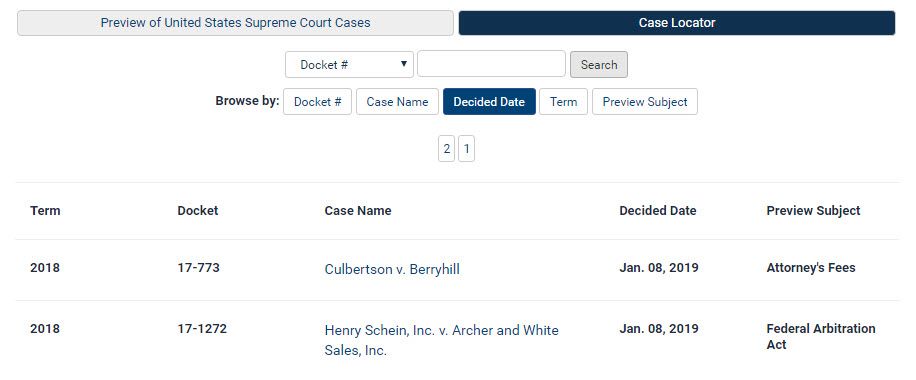
Screenshot of Case Locator in Preview of the United State Supreme Court Cases

For more information about searching and browsing the Preview database, check out the LibGuide!


Using Preview in the Classroom

Preview is a great resource to use in your classroom to make sure your students are up to date with current events that affect the nation. Each month, the American Bar Association features a current case before the Court along with a modified case study and focus questions for classroom use. Users can access these ready-to-use resources through the American Bar Association. These resources include:

  • Background on the Legal Issue: Each case study provides key definitions relating to the case, as well as the case at a glance and the facts of the case.
  • Argument Summaries: The issue that is brought before the court is defined and includes argument summaries from both sides of the case.
  • Focus Questions: Insight focus questions are provided to promote and provoke dialogue regarding different aspects of the case.

Pricing Information

Online-only subscription pricing:

Organizationsโ€ฆโ€ฆโ€ฆโ€ฆโ€ฆโ€ฆโ€ฆโ€ฆโ€ฆโ€ฆโ€ฆโ€ฆโ€ฆโ€ฆโ€ฆ.โ€ฆโ€ฆโ€ฆโ€ฆโ€ฆโ€ฆโ€ฆโ€ฆโ€ฆโ€ฆโ€ฆโ€ฆโ€ฆโ€ฆโ€ฆ.$175.00
Individuals (Non-ABA Members)โ€ฆโ€ฆโ€ฆโ€ฆโ€ฆโ€ฆโ€ฆโ€ฆโ€ฆโ€ฆ..โ€ฆโ€ฆโ€ฆโ€ฆโ€ฆโ€ฆโ€ฆโ€ฆ$130.00
Individuals (ABA Members)โ€ฆโ€ฆโ€ฆโ€ฆโ€ฆโ€ฆโ€ฆโ€ฆโ€ฆโ€ฆโ€ฆโ€ฆโ€ฆโ€ฆโ€ฆโ€ฆโ€ฆโ€ฆโ€ฆโ€ฆโ€ฆโ€ฆ$120.00
Undergraduate/Law Studentsโ€ฆโ€ฆโ€ฆโ€ฆโ€ฆโ€ฆโ€ฆโ€ฆโ€ฆ..โ€ฆโ€ฆโ€ฆโ€ฆโ€ฆโ€ฆโ€ฆโ€ฆโ€ฆโ€ฆโ€ฆ..$25.00
K-12 Teachers..โ€ฆโ€ฆโ€ฆโ€ฆโ€ฆโ€ฆโ€ฆโ€ฆโ€ฆโ€ฆโ€ฆโ€ฆโ€ฆโ€ฆโ€ฆโ€ฆโ€ฆโ€ฆโ€ฆโ€ฆโ€ฆโ€ฆโ€ฆโ€ฆโ€ฆโ€ฆโ€ฆโ€ฆโ€ฆโ€ฆ..$25.00

Hard bound Volume*โ€ฆโ€ฆโ€ฆโ€ฆโ€ฆโ€ฆโ€ฆโ€ฆโ€ฆโ€ฆโ€ฆโ€ฆโ€ฆโ€ฆ.โ€ฆโ€ฆโ€ฆโ€ฆโ€ฆโ€ฆ.โ€ฆโ€ฆโ€ฆโ€ฆโ€ฆโ€ฆ$75.00

*Hardbound volume is only available to online subscribers.


Upcoming Cases for the 2019-2020 Term

Wondering what cases will be argued in front of the Supreme Court this upcoming term? See below for a brief overview.

A case in which the Court will decide whether the Copyright Remedy Clarification Act validly abrogates state sovereign immunity to allow authors of original expression to sue states who infringe their federal copyrights.

A case in which the Court will decide whether Title VII of the Civil Rights Act of 1964, which prohibits against employment discrimination โ€œbecause of . . . sex,โ€ encompasses discrimination based on an individualโ€™s sexual orientation.

A case in which the Court will decide whether the U.S. Forest Service has the authority to grant rights-of-way under the Mineral Leasing Act through lands traversed by the Appalachian Trail within national forests.

ย A case in which the Court will decide whether and under what circumstances a timely Rule 59(e) motion to โ€œamend or alterโ€ the Courtโ€™s judgment should be recharacterized as a second or successive habeas petition under Gonzalez v. Crosby, 545 U.S. 524 (2005).

A case in which the Court will decide whether a lawfully admitted permanent resident who is not seeking admission to the United States can be โ€œrender[ed] . . . inadmissibleโ€ for the purposes of the stop-time rule, 8 U.S.C. ยง 1229b(d)(1).

A case in which the Court will resolve a circuit split as to whether under federal maritime law a safe-berth clause in a voyage charter contract is a guarantee of a shipโ€™s safety (as the Second Circuit and Third Circuit held) or a duty of due diligence (as the Fifth Circuit held).

A case in which the Court will decide whether a claim of race discrimination under 42 U.S.C. ยง 1981 is a showing of but-for causation or only that race is a motivating factor.

A case in which the Court will decide whether the Clean Water Act requires a permit when pollutants originate from a point source but are conveyed to navigable waters by a nonpoint source, such as groundwater.

A case in which the Court will decide (1) whether the Department of Homeland Securityโ€™s decision to wind down the Deferred Action for Childhood Arrivals (DACA) policy is judicially reviewable; and (2) whether DHSโ€™s decision to wind down the DACA policy is lawful.

A case in which the Court will decide whether 35 U.S.C. ยง 314(d) permits appeal of the Patent Trial and Appeal Boardโ€™s decision to institute an inter partes review upon finding that 35 U.S.C. ยง 315(b)โ€™s time bar did not apply.

A case in which the Court will decide whether a state law that provides funding for education but excludes religious education options violates the Religion Clauses or the Equal Protection Clause of the Federal Constitution.

A group of cases in which the Court will decide the constitutionality of President Barack Obamaโ€™s appointments (without their being confirmed by the Senate) to the oversight board created to help Puerto Rico recover from its substantial indebtedness.

A case in which the Court will decide whether the Convention on the Recognition and Enforcement of Foreign Arbitral Awards permits a nonsignatory to an arbitration agreement to compel arbitration based on the doctrine of equitable estoppel.

A case in which the Court will decide whether the government edict doctrine extends toโ€”and thus renders uncopyrightableโ€”the annotations in the Official Code of Georgia Annotated.

A case in which the Court will decide whether a request for equitable tolling, as it applies to statutory motions to reopen, is judicially reviewable as a โ€œquestion of lawโ€ or instead is unreviewable as a โ€œquestion of fact.โ€

A case in which the Court will decide whether, when plaintiffs plausibly allege that a rogue federal law enforcement officer violated clearly established Fourth and Fifth Amendment rights for which there is no alternative legal remedy, the federal courts can and should recognize a claim of damages under Bivens v. Six Unknown Named Agents, 403 U.S. 388 (1971).

A case in which the Court will decide whether a criminal defendant must make a formal objection after the pronouncement of the sentence to invoke appellate reasonableness review of the length of the sentence.

A case in which the Court will decide whether the three-year limitations period in Section 413(2) of the Employee Retirement Income Security Act (ERISA), 29 U.S.C. ยง 1113(2)โ€”which runs from โ€œthe earliest date on which the plaintiff had actual knowledge of the breach or violationโ€โ€”bars suit if the defendants disclosed to the plaintiff all relevant information more than three years before the plaintiff filed the complaint, but the plaintiff chose not to read or could not recall having read the information.

A case in which the Court will decide whether the decision by the U.S. Court of Appeals for the Fifth Circuit upholding Louisianaโ€™s law requiring physicians who perform abortions to have admitting privileges at a local hospital conflicts with the Courtโ€™s binding precedent in Whole Womanโ€™s Health v. Hellerstedt.

A case in which the Court will decide whether the Eighth and Fourteenth Amendments allow a state to abolish the insanity defense.

A case in which the Court will decide (1) whether the Immigration Reform and Control Act (IRCA) expressly preempts states from using information provided on a federal Form I-9 in a prosecution of any person when the same information also appears in non-IRCA documents; and (2) whether the Act impliedly preempts Kansasโ€™s prosecution of the respondents in this case.

A case in which the Court will decide whether, for purposes of an investigative stop under the Fourth Amendment, it is reasonable for an officer to suspect that the registered owner of a vehicle is the one driving the vehicle absent any information to the contrary.

A case in which the Court will decide whether a public official โ€œdefraud[s]โ€ the government of its property by advancing a โ€œpublic policy reasonโ€ for an official decision that is not her subjective โ€œreal reasonโ€ for making the decision.

A case in which the Court will decide whether, when a plaintiff asserts new claims, federal preclusion principles can bar a defendant from raising defenses that were not actually litigated and resolved in any prior case between the parties.

Several cases in which the Court will decide whether an appropriations rider whose text bars the agencyโ€™s use of certain funds to pay a statutory obligation, but does not repeal or amend the statutory obligation, does in fact impliedly repeal the obligation, and whether the presumption against retroactivity applies to the interpretation of such an appropriations rider.

A case in which the Court will decide whether its prior decision regarding constitutional rules for sentencing juveniles is a substantive rule of constitutional law and thus retroactive, as the U.S. Court of Appeals for the Fourth Circuit, below, concluded in direct conflict with Virginiaโ€™s highest court.

A case in which the Court will decide (1) whether the Arizona Supreme Court was required to apply current law, rather than the law as it existed at the time a defendantโ€™s conviction became final, when weighing mitigating and aggravating evidence to determine whether a death sentence is warranted; and (2) whether the correction of error under Eddings v. Oklahoma, 455 U.S. 104 (1982), requires resentencing.

A case in which the Court will decide (1) the proper standard of review of a district courtโ€™s determination of habitual residence under the Hague Conventionโ€”de novo, a deferential version of de novo, or for clear error; and (2) whether, when an infant is too young to acclimate to her surroundings, a subjective agreement between the infantโ€˜s parents is necessary to establish her habitual residence under the Hague Convention.

A case in which the Court will decide whether New York Cityโ€™s ban on transporting a licensed, locked, and unloaded handgun to a home or shooting range outside city limits is consistent with the Second Amendment, the Commerce Clause, and the constitutional right to travel.

A case in which the Court will decide whether the Foreign Sovereign Immunities Act (FSIA) applies retroactively, thereby permitting recovery of punitive damages against foreign states for terrorist activities occurring prior to the passage of the current version of the statute.

A case in which the Court will decide whether the phrase โ€œ[a]ll the expenses of the proceedingsโ€ in 35 U.S.C. ยง 145 include attorneysโ€™ fees incurred as a result of defending the agency in ยง 145 litigation.

A case in which the Court will decide whether Title VII of the Civil Rights Act of 1964 prohibits discrimination against transgender employees based on (1) their status as transgender or (2) sex stereotyping under Price Waterhouse v. Hopkins, 490 U.S. 228 (1989).

A case in which the Court will decide whether the Fourteenth Amendment fully incorporates the Sixth Amendmentโ€™s guarantee of a unanimous verdict against the states.

A case in which the Court will decide whether generalized allegations that the harm of an inevitable disclosure of an alleged fraud generally increases over time satisfy the โ€œmore harm than goodโ€ pleading standard for ERISA claims the Court established in Fifth Third Bancorp v. Dudenhoeffer.

A case in which the Court will decide whether an order denying a motion for relief from the automatic stay in bankruptcy proceeding is a final order under 28 U.S.C. ยง 158(a)(1).

A case in which the Court will decide whether federal common law or the law of the relevant state determines the ownership of a tax refund paid to an affiliated group.

A case in which the Court will decide whether, under Section 35 of the Lanham Act, willful infringement is a prerequisite for an award of an infringerโ€™s profits for a violation of Section 43(a).

A case in which the Court will resolve a circuit split as to when the one-year statute of limitations under the Fair Debt Collection Practices Act beginsโ€”when the violation is discovered, as the Fourth and Ninth Circuits have held, or on the date the violation occurred, as the Third Circuit held below.

A case in which the Court will decide whether the determination of a โ€œserious drug offenseโ€ under the Armed Career Criminal Act requires the same categorical approach used in the determination of a โ€œviolent felonyโ€ under the act.

A case in which the Court will decide whether an ERISA plan participant may seek injunctive relief or restoration of plan losses caused by fiduciary breach without demonstrating individual financial loss or the imminent risk thereof.

A case in which the Court will decide whether the federal law making it a crime to encourage or induce illegal immigration for commercial advantage or private financial gain is unconstitutional on its face.

Donโ€™t fall behind with the times. Stay in the know with HeinOnline: Tweet us, like us, follow us, and watch us!

You Might Also Like
Tip of the Week
Tip of the Week: How To Locate the Model Penal Code

The Model Penal Code (MPC), a legal framework developed by the American Law Institute, standardizes U.S. criminal law and guides state statutes. Learn how to find the Model Penal Code in this blog post.

Tip of the Week
Tip of the Week: How To Locate the Model Penal Code

The Model Penal Code (MPC), a legal framework developed by the American Law Institute, standardizes U.S. criminal law and guides state statutes. Learn how to find the Model Penal Code in this blog post.

Like what you see?

There’s plenty more where that came from! Subscribe to the HeinOnline Blog to receive posts like these right to your inbox.

By entering your email, you agree to receive great content from the HeinOnline Blog. HeinOnline also uses the information you provide to contact you about other content, products, and services we think you’ll love.

Like what you're reading? Subscribe to the blog!